Contact centers are under more pressure than ever. Customers expect instant answers, seamless experiences across channels, and personalized service every time. At the same time, leaders must control costs, reduce churn, and keep agents engaged in a demanding environment.
Agent assist contact centre solutions bring artificial intelligence directly into the agent desktop, turning every conversation into a smarter, faster, and more consistent interaction. Rather than replacing humans, agent assist acts as a real-time co-pilot that supports agents with instant knowledge, guidance, and automation.
This article explains what agent assist in the contact center is, how it works, and the concrete benefits it delivers for customers, agents, and the business, highlighting the advantages of adopting call center AI.
As organizations adopt AI technologies, they increasingly look for ways to improve collaboration and operational efficiency. For example, investing in a distributed computing network for better performance allows teams to handle large workloads without overloading individual systems. This approach can directly enhance the responsiveness of an agent assist contact centre by reducing wait times for information and automating repetitive tasks.
Modern contact centers also benefit from integrating tools like high-performance supercomputers for AI-driven analytics. Leveraging such infrastructure enables advanced predictive insights, helping agents anticipate customer needs and provide faster, more accurate solutions. When AI suggestions are powered by robust systems, agent productivity and satisfaction see significant gains.
In addition to technical infrastructure, marketing and customer engagement strategies are critical. Companies exploring innovative customer experience marketing tactics can align AI insights with campaigns that improve personalization and conversion. Combining human agents with AI-driven suggestions ensures every interaction is more relevant, timely, and effective, ultimately enhancing customer loyalty.
For brands looking to scale efficiently, marketing platforms that boost customer retention and engagement offer actionable data to refine service processes. When these insights feed into the agent assist workflow, agents can resolve issues with tailored recommendations, minimizing escalations and improving overall satisfaction.
Financial planning and performance also play a role in sustaining long-term contact center operations. Using trusted financial guidance for business technology investments helps organizations budget wisely for AI deployments while evaluating ROI from efficiency gains and reduced churn. Investing in agent assist tools with the right strategy ensures the solution delivers measurable business value.
Top 10 Agent Assist Contact Centre Solutions in 2025
Choosing the right agent assist contact centre software can transform customer service, improve agent efficiency, and boost overall customer satisfaction. Here are the top solutions in 2025 that are helping businesses stay ahead.
1. Bright Pattern
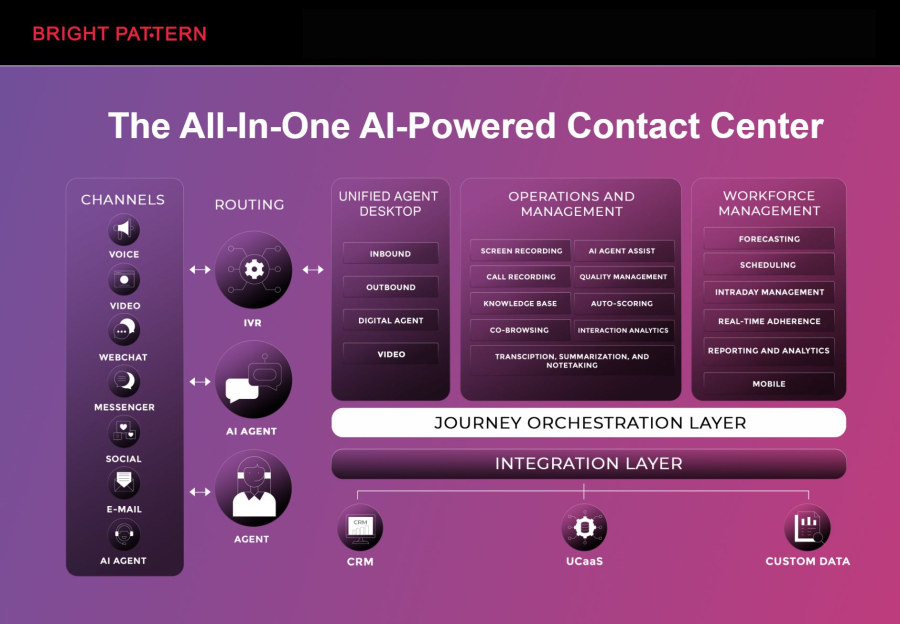
Bright Pattern leads the market in agent assist contact centre technology by combining AI-powered assistance with an intuitive agent interface. Its platform focuses on enhancing agent productivity, automating repetitive tasks, and delivering consistent customer experiences across channels.
Key features include:
- Real-time AI guidance during customer interactions
- Omnichannel support including voice, chat, email, and social messaging
- Easy integration with CRM and back-office systems
- Analytics dashboard for monitoring agent performance and customer satisfaction
- Customizable workflows to suit different business needs
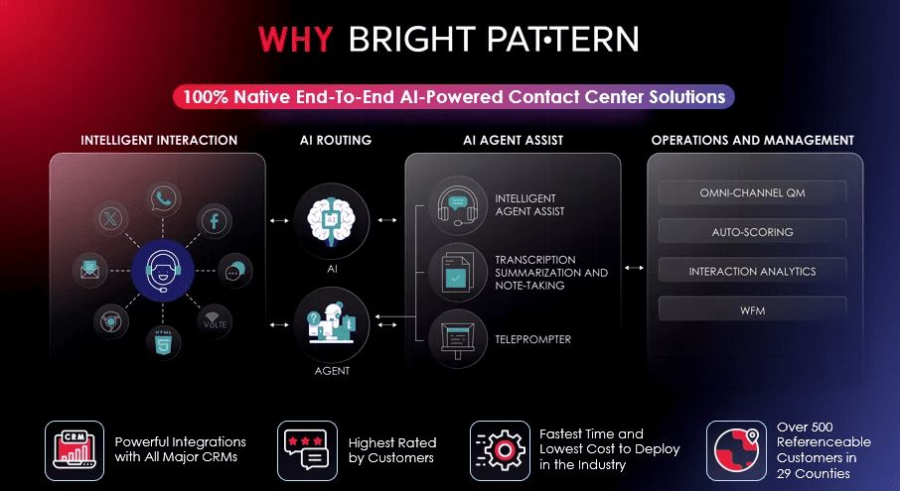
With Bright Pattern, organizations can leverage AI to provide agents with instant knowledge and next-best-action suggestions, ensuring every conversation is accurate, efficient, and customer-focused. Businesses adopting this platform report faster resolution times, reduced agent burnout, and higher customer retention.
2. Genesys
Genesys offers AI-powered contact center solutions designed to streamline workflows and improve customer engagement. Its AI agent assist features provide real-time recommendations and sentiment analysis to agents.
3. NICE inContact
NICE inContact combines cloud contact center technology with agent assist AI, delivering predictive routing, automation, and performance analytics to optimize agent efficiency.
4. 8x8 Contact Center
8x8 focuses on integrating AI for agent guidance, omnichannel communication, and customer insights, enabling agents to handle complex queries faster.
5. RingCentral Contact Center
RingCentral provides a cloud-based agent assist contact centre platform with real-time coaching, AI recommendations, and comprehensive reporting to improve service quality.
6. Talkdesk
Talkdesk leverages AI to assist agents with smart suggestions, automated workflows, and enhanced analytics for better decision-making during customer interactions.
7. Five9
Five9 uses AI-driven agent assistance to deliver predictive dialing, real-time guidance, and performance monitoring for more efficient contact center operations.
8. Cisco Contact Center
Cisco integrates AI features that help agents respond quickly, provide relevant recommendations, and improve the overall customer experience with automated assistance tools.
9. Avaya OneCloud
Avaya OneCloud provides agent assist capabilities with AI-powered suggestions, omnichannel support, and seamless CRM integration to enhance customer interactions.
10. Salesforce Service Cloud
Salesforce Service Cloud delivers AI-driven agent assistance, predictive analytics, and automation features, enabling agents to resolve customer queries faster and more accurately.
What Is Agent Assist in a Contact Center?
Agent assistis a set of AI-powered tools that support live agents during customer interactions across voice, chat, email, social, and other channels. It listens to or reads the conversation as it happens, understands context and intent, and then surfaces the right information or recommended actions in real time.
Instead of agents searching multiple systems, scrolling through long knowledge articles, or asking supervisors for help, agent assist delivers answers and guidance directly within their workflow.
Typical agent assist capabilities include:
- Real-time suggestions for knowledge base articles and next best actions
- Automatic call or chat summarization and after-contact notes
- Guided workflows and dynamic scripts based on customer context
- Compliance and quality monitoring with proactive alerts
- Sentiment and intent detection to flag at-risk interactions
- Automated data entry, disposition codes, and case creation
Why Agent Assist Matters Now
Several converging trends make agent assist especially powerful and timely for modern contact centers:
- Rising customer expectationsfor speed, accuracy, and personalization across every interaction.
- Increasing complexityof products, services, and policies that agents must understand and explain.
- Workforce challengesincluding high turnover, longer onboarding times, and hybrid or remote teams.
- Pressure on operational efficiencyto control costs while delivering differentiated service.
- Maturity of AI technologiessuch as natural language processing and generative AI that can now operate reliably in real time.
Agent assist directly addresses these challenges by making every agent more capable, regardless of tenure or location, and by embedding intelligence into everyday workflows.
Core Benefits of Agent Assist for Contact Centers
When implemented thoughtfully, agent assist delivers benefits that compound across the entire operation.
1. Faster, More Accurate Resolutions
Agent assist tools quickly understand the customer issue and match it with relevant content or actions, helping agents resolve queries more efficiently.
- Reduced handle timeas agents spend less time searching systems or putting customers on hold.
- Higher first-contact resolutionbecause the right answer is surfaced during the initial interaction.
- Fewer transfers and escalationsas frontline agents gain the confidence and tools to solve more complex issues.
2. Consistent, Compliant Interactions
Agent assist promotes consistency across agents and channels by embedding policies and best practices into the guidance it provides.
- Standardized responsesbased on approved knowledge and scripts.
- Proactive compliance checksthat highlight required disclosures, consent statements, or verification steps.
- Reduced riskof regulatory or contractual violations through real-time coaching and alerts.
3. Happier, More Productive Agents
By removing friction from agents’ daily work, agent assist can significantly improve the employee experience.
- Less cognitive loadas agents no longer need to memorize complex policies or navigate dozens of screens.
- Shorter ramp-up timefor new hires, who can rely on AI guidance while they learn.
- Higher engagement and job satisfactionas agents spend more time solving problems and building relationships, and less time doing repetitive tasks.
4. Stronger Customer Satisfaction and Loyalty
When interactions become faster, more accurate, and more personalized, customer satisfaction naturally improves.
- Reduced effortfor customers who no longer have to repeat information or endure long waits.
- More human interactionsbecause agents can focus on empathy and communication while AI handles routine tasks.
- Improved trust and loyaltyas customers experience consistent, high-quality service across channels.
5. Better Insights and Continuous Improvement
Agent assist tools generate rich data on customer intents, common issues, and effective resolutions.
- Deeper analyticson why customers contact you and which solutions work best.
- Faster content optimizationas gaps in the knowledge base become visible in real time.
- Data-driven coachingwith call summaries and performance indicators that help managers train more effectively.
How Agent Assist Works in Practice
While specific implementations vary, most agent assist solutions follow a similar flow.
Step 1: Capture and Understand the Interaction
- Forvoice calls, the system transcribes speech in real time into text.
- Fordigital channelslike chat, email, or messaging, it processes the text directly.
- Natural language processing (NLP) identifies the customer’s intent, key entities (such as names, products, and account details), and sentiment.
Step 2: Match Context to Knowledge and Actions
- The AI engine compares the current context to the knowledge base, past interactions, and configured workflows.
- It selects relevant articles, troubleshooting steps, or next best actions that are likely to resolve the issue.
- Business rules ensure that guidance complies with policies and reflects customer profile and entitlements.
Step 3: Surface Real-Time Guidance to the Agent
- Recommendations appear within the agent’s desktop, CRM, or unified workspace.
- Agents can quickly review suggested responses, steps, or offers before using them.
- Context is updated continuously as the conversation evolves, so guidance remains relevant.
Step 4: Automate Documentation and After-Call Work
- The system generates concise summaries of the interaction, including reason for contact and outcomes.
- Disposition codes or categories can be suggested based on the conversation.
- Follow-up tasks or cases may be created automatically, reducing manual data entry.
Key Agent Assist Use Cases in Contact Centers
Agent assist can be applied across a wide variety of scenarios. Below are some high-impact use cases.
Onboarding and Training New Agents
New agents are often overwhelmed by the volume of information they must learn. Agent assist acts as an always-available coach.
- Guided workflows walk new hires through complex procedures step by step.
- Suggested responses ensure that customer communications stay on-brand and accurate.
- Supervisors can focus coaching on soft skills, knowing that the AI supports factual accuracy.
Supporting Complex Technical or Policy Inquiries
In industries with detailed regulations or technical products, even experienced agents sometimes struggle to recall specific details.
- Agent assist immediately surfaces the latest approved policies and troubleshooting guides.
- Dynamic scripts adapt based on the customer’s answers and system data.
- Agents can confidently navigate nuanced situations without long holds or transfers.
Sales and Cross-Sell Opportunities
Contact centers are often key revenue drivers. Agent assist helps agents identify and present relevant offers without feeling pushy.
- Next best offer suggestions based on customer profile, history, and real-time intent.
- Compliance-friendly scripts for disclosures and terms.
- Guidance on timing and phrasing to keep the interaction customer-centric.
Retention and Save Desk Scenarios
When customers are at risk of churning, every second counts. Agent assist provides instant access to save strategies.
- Real-time sentiment detection flags high-risk conversations to supervisors.
- Recommended retention offers and talking points help agents handle objections.
- Summaries of customer history give agents a complete view of the relationship.
Quality, Compliance, and Risk Management
Traditional quality monitoring is often manual and retrospective. Agent assist brings quality and compliance into the moment.
- Real-time prompts remind agents of mandatory disclosures or verification steps.
- Potentially risky language can be flagged before it becomes a compliance issue.
- Post-interaction summaries support targeted quality reviews and coaching.
Before and After Agent Assist: What Changes?
The impact of agent assist is easiest to understand by comparing a typical contact center workflow before and after implementation.
| Aspect | Before Agent Assist | After Agent Assist |
| Finding Information | Agents search multiple systems, ask peers, or place customers on hold. | Relevant content and steps appear automatically based on live context. |
| Consistency | Responses vary by agent experience, memory, and personal notes. | Guidance is based on a single, current source of truth and best practices. |
| After-Call Work | Manual notes, coding, and case creation add time and errors. | Summaries and dispositions are suggested or automated, reducing effort. |
| Coaching | Supervisors review limited samples of recorded calls after the fact. | Real-time alerts and rich summaries support timely, targeted coaching. |
| Agent Experience | High stress, information overload, and slow ramp-up for new hires. | Confidence grows as AI handles routine tasks and supports complex ones. |
Evaluating Success: Metrics for Agent Assist Initiatives
To demonstrate value and refine your approach, it is important to track the right metrics.
Operational Efficiency Metrics
- Average handle time (AHT)for calls and chats.
- After-call work (ACW)time per interaction.
- First-contact resolution (FCR)rates.
- Transfer and escalation ratesacross queues or tiers.
Customer Experience Metrics
- Customer satisfaction (CSAT)scores and feedback comments.
- Net promoter score (NPS)and loyalty indicators where applicable.
- Customer effort score (CES)for key journeys.
Agent Experience and Performance Metrics
- Agent satisfactionand engagement survey results.
- Time to proficiencyfor new hires.
- Adherence to scripts and policieswithout sacrificing empathy.
- Coaching effectivenessbased on before and after performance.
Business Impact Metrics
- Cost per contactacross channels.
- Revenue per interactionin sales or retention scenarios.
- Churn and retention ratesfor key customer segments.
- Compliance incidentsand related risk indicators.
Implementing Agent Assist in Your Contact Center
A successful agent assist rollout is as much about strategy and change management as it is about technology. The following steps can guide your implementation.
1. Define Clear Objectives and Use Cases
Start with outcomes, not features. Identify where agent assist can create the most value in your environment.
- Prioritize a few high-volume or high-impact call and chat types.
- Align objectives with business goals such as reducing handle time, improving CSAT, or accelerating onboarding.
- Engage frontline leaders and agents early to gather insights and build buy-in.
2. Prepare Your Knowledge and Processes
Agent assist is only as strong as the content and processes behind it.
- Audit your knowledge base for accuracy, completeness, and usability.
- Update or consolidate overlapping articles and remove outdated content.
- Document key workflows and decision trees so they can be reflected in recommendations.
3. Integrate with Existing Systems
For maximum impact, agent assist should fit seamlessly into your current ecosystem.
- Connect to your CRM, ticketing, and telephony or contact center platform.
- Ensure that agents do not need to switch screens or tools to use recommendations.
- Plan for secure handling of customer data and appropriate access controls.
4. Pilot, Learn, and Iterate
Begin with a controlled pilot rather than a big-bang rollout.
- Select one or two teams or queues as early adopters.
- Monitor quantitative metrics as well as qualitative feedback from agents and supervisors.
- Refine prompts, knowledge content, and UX based on real-world usage before scaling.
5. Support Change Management and Training
Agent assist is a powerful ally for agents, but they must trust and understand it to use it fully.
- Communicate clearly that AI is there to support agents, not replace them.
- Provide practical training focused on real scenarios and hands-on use.
- Recognize and celebrate early successes to reinforce adoption.
Best Practices for Maximizing Value
To capture the full benefits of agent assist in your contact center, consider the following best practices.
Keep the Human in Control
- Design the system so that agents can review and edit suggestions before sending.
- Encourage agents to use their judgment and escalate when something does not feel right.
- Collect feedback on inaccurate or unhelpful recommendations and use it to improve models and content.
Start Simple, Then Expand
- Begin with a few focused use cases where success is easy to measure.
- Add more workflows and channels over time as the organization gains confidence.
- Avoid overwhelming agents with too many suggestions or features at once.
Design for Agent Experience First
- Involve agents in user experience design and testing.
- Ensure that guidance is clear, concise, and easy to act on during live conversations.
- Limit screen clutter and prioritize the most relevant information.
Continuously Improve Content and Models
- Use interaction data to identify new topics and update the knowledge base regularly.
- Review call summaries and suggestions to spot patterns and optimization opportunities.
- Collaborate across operations, training, and knowledge management teams to keep content aligned.
The Future of Agent Assist in Contact Centers
As AI capabilities continue to advance, agent assist will become even more powerful and intuitive.
- More natural guidancewith AI that understands nuance and context across entire customer journeys.
- Proactive assistancethat anticipates needs before they are explicitly stated.
- Tighter integrationwith self-service bots, so human agents can seamlessly pick up and continue automated conversations.
- Richer coaching toolsthat help agents develop skills over time based on personalized insights.
What will not change is the central role of human empathy and judgment. Agent assist enhances, rather than replaces, the human connection at the heart of every great customer experience.
Conclusion: Turning Every Agent into a Top Performer
Agent assist contact center solutions bring together the best of AI and human talent. By providing real-time guidance, automating routine work, and unlocking powerful insights, they enable agents to deliver faster, more accurate, and more empathetic service.
Organizations that embrace agent assist thoughtfully can shorten training time, improve operational efficiency, boost customer satisfaction, and create a more engaging workplace. With a clear strategy, strong change management, and a focus on agent experience, your contact center can turn every interaction into an opportunity to delight customers and strengthen loyalty.
